There’s a hedge fund on Mount Street that runs its own white-glove test, except it isn’t a glove. It’s the managing partner’s shirt cuff. He rests a forearm on the reception desk while he waits for his car, and if the cuff comes away with a grey line on it, somebody hears about it well before lunch.
That’s the standard. Not “clean.” Unmarked.
An office in Mayfair or Belgravia is not an ordinary commercial cleaning job wearing a better postcode, and the firms that treat it like one get found out inside a month.
What makes a Mayfair office different from an office anywhere else?
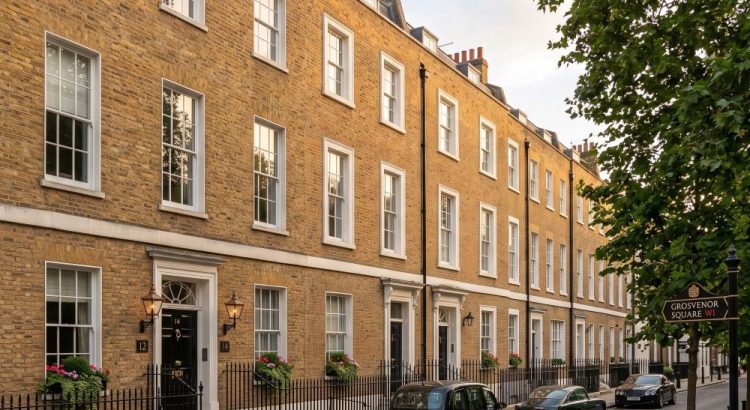
The buildings first. Most of Mayfair’s offices are nothing a business park would recognise as an office. They’re Georgian townhouses – four and five storeys of listed brick and plaster off Berkeley Square and up Grosvenor Street – with a hedge fund or a family office poured into rooms built as drawing rooms two centuries ago. The cornicing is original and the staircase is listed. The floor is very often the parquet the original builders laid, and you cannot put a scrubber-dryer anywhere near it.
Then the tenants. Mayfair money is quiet money. Private equity on Curzon Street, a single-family office tucked over a gallery on Cork Street – the sort of quiet name you’ve never heard precisely because you were never meant to. For these people the house is a statement of seriousness before a word is spoken, and a smeared glass door or a pale ring left on the boardroom table reads to a visiting client as a hairline crack in the whole edifice. Fair or not, that’s how it lands.
The Grosvenor Estate is watching
Nearly all of Mayfair and almost the whole of Belgravia sits on land the Grosvenor family has held since the early 1700s, and the estate has never once stopped minding how its buildings look.
In Belgravia it’s written into the fabric of the place. Thomas Cubitt built those wedding-cake stucco terraces around Belgrave Square and Eaton Square for the Grosvenors in the 1820s and 30s, and the leases that govern them still carry covenants about upkeep and appearance. A landlord’s surveyor who walks past a tired-looking front-of-house is not a problem any tenant wants climbing the chain. The cleaning is part of how a tenant keeps the estate content. Nobody puts that in the contract, and everybody in the building knows it anyway.
What does “white glove” actually mean once you’re inside the house?
Every mid-market firm with a nice logo puts “white glove” on the website, so here’s what it means on the ground in W1 rather than in a brochure.
The work is invisible, and so are the people doing it. No trolley parked across reception at half past eight. No wet-floor cones flanking the front door as the first partner walks in. In a Georgian house where the whole point of the ground floor is the impression it makes in the ninety seconds a visitor stands in it, the cleaning has to have happened and to have left no trace of itself, like a stage reset between scenes.
It also means detail at a level that would look neurotic anywhere else and is simply the baseline here. The underside of the brass stair rail. The skirting behind the umbrella stand. The particular corner of the boardroom glass where the low winter sun through the sash window finds every smear at four in the afternoon.
The measure is what you don’t notice
You judge an ordinary office clean by what’s been done. You judge this one by what you can’t find. Nobody in that Mount Street reception thinks, each morning, how clean it looks. They only ever notice the day the cuff comes up grey.
Why do the surfaces themselves demand specialist care?
This is the part that separates a genuine white-glove operation from a merely expensive one, and it’s where most of the harm in these buildings gets done – slowly, by people trying their best with the wrong bottle.
Nearly every surface in the house can be wrecked by the wrong product, most of them without a sound. Marble is the first landmine, because it’s all over these receptions and washrooms, and marble is calcium carbonate, which means anything acidic eats it. Not scratches it. Eats it. The polished top goes dull and faintly rough exactly where the acid sat, and there’s no wiping that back – it returns only with a re-hone and re-polish by a stone specialist, at a price that makes the client go quiet.
I got called to a reception on Grosvenor Street where a perfectly diligent night cleaner had spent a month spraying supermarket limescale remover around the water cooler, sure she was being thorough. By the time anyone joined the dots there was a dull halo etched into the marble in a ring the exact shape of the cooler’s drip zone. That floor cost more to put right than a year of the cleaning contract.
Then the parquet, the other thing people ruin with kindness. A wet mop on a two-hundred-year-old timber floor drives water down into the joints, the blocks swell and lift, and the herringbone in the entrance hall starts to cup and tent. These floors want a barely-damp cloth and a great deal of restraint. Brass wants a non-abrasive polish and a soft cloth, not the pink cream that strips the lacquer and leaves the metal tarnishing twice as fast a fortnight on. Silk wallpaper wants almost nothing at all. Gilt frames, leather chair backs, the veneer on a partner’s desk, the marble again in the client WC – every one of them has a right method and several wrong ones, and the wrong ones are nearly always the faster ones, which is the whole trouble.
There’s the high stuff, too, which the average contract forgets exists until a bulb goes. The plaster cornice sixteen feet up. The chandelier in the first-floor meeting room that hasn’t been touched since the last tenant, greying quietly above everyone’s heads. Add the tops of the tall sash windows, where London’s air leaves a film you only see when the sun’s low and a client’s already sitting there. Reaching that work safely, in an occupied listed building, without a tower scaffold blocking the hall all morning, is its own small trade – and it’s the first thing to fall off a schedule when a firm has priced the job too keenly to afford the hours.
Vinegar on marble is vandalism
Here’s an opinion that annoys people. The fashion for “natural” cleaning – the white vinegar, the lemon juice someone’s brought in from home because it’s kinder than the blue stuff – is a menace in a Mayfair house, and I’ll defend that to anyone. Vinegar is acetic acid. Lemon is citric acid. On a marble reception desk they do exactly what the harshest chemical does, arguably worse, because they turn up wrapped in the confidence of being gentle. On stone, “green” only tells you nobody read the label with the floor in mind.
Who is actually allowed through the door?
A cleaner in a Mayfair hedge fund walks past open screens and term sheets left face-up on the desks, and there’s usually a whiteboard nobody thought to wipe. Discretion in these buildings is a service in its own right, running alongside the cleaning the whole time and mattering every bit as much.
Which is why vetting here goes well beyond the two references a normal contract asks for – DBS checks and a verified work history going back years, often with a signed confidentiality agreement covering the cleaner as tightly as it covers the account manager. The firms that hold this work keep the same faces on the same building for years, because trust is built on the seventh visit rather than the first, and a house full of confidential money does not want an agency temp it’s never met wandering the third floor at seven in the evening.
Belgravia and the embassy problem
Belgravia lifts the bar again, because Belgravia is where the embassies are. Belgrave Square alone is ringed with them, flags on half the porticoes, and a diplomatic building is a different order of sensitive altogether. Contractors working those addresses may need security-cleared staff and escorted access, with a level of background checking a family office three streets away would think excessive and an embassy considers Tuesday. Not every firm can even be put forward. Most can’t.
Why does a day porter earn its keep in these buildings?
Because the front of house has to be immaculate at eight in the morning and still immaculate at half past five, and a night crew that clocked off at six can do nothing about the coffee that goes over in reception at eleven.
The good Mayfair and Belgravia buildings run a day porter – a discreet, well-presented member of staff who lives in the building through the working day, keeping the ground floor faultless and catching the spill before the client sees it rather than eight hours later. The role blurs at the edges into something more than cleaning: resetting the boardroom between back-to-back meetings, or quietly taking in a delivery so a courier never crosses reception at the wrong moment.
One porter over a whole night crew
One porter who’s there at the right moment is worth more in these houses than a whole night crew that comes and goes in the dark. The night team does the deep work, the floors that need hours and an empty building. The porter holds the line all day, and in a house whose entire value is the impression it makes, the line is the product.
That’s the cuff on the Mount Street desk, in the end. Somebody has to see to it that it comes up clean at eleven in the morning, with no cleaner anywhere in sight.