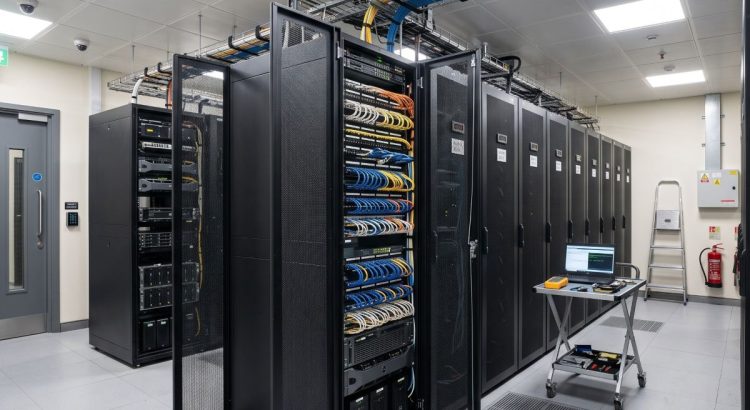
Most of the server rooms I get called into across Greater London aren’t server rooms. They’re cupboards.
A converted stationery store off a corridor in Clerkenwell. A partitioned corner of an open-plan floor in Shoreditch. A rather beautiful stretch of exposed Victorian brick in Farringdon that someone decided to fill with forty grand of switches and a wall-mounted split unit that wheezes when it thinks about working. The kit inside is doing serious work. The room it sits in was an afterthought, and that mismatch is where most of the trouble starts.
Why does a bit of dust matter so much in the first place?
Dust in a comms room isn’t a cosmetic issue. Every fan in that rack pulls air across hot components, and it drags whatever is floating in the room in with it. Fine particulate settles on heat sinks. It clogs intake filters. It coats fan blades until they spin slower and louder, and the kit starts running hotter than it was ever designed to. Hot kit throttles. A throttled processor behaves like a cheaper processor you didn’t pay for, and if the thermal cycling carries on long enough it works its way into solder joints and spinning drives, shortening their lives in ways nobody notices until a Tuesday morning when a drive doesn’t come back up.
Then there’s static, which is the part people forget.
Dry, dusty air holds a charge. Drag a nylon-bristled brush or a domestic vacuum hose across a rack in a low-humidity room and you can generate enough electrostatic discharge to wound components you never even touched. You won’t see it happen. ESD damage is usually latent – the board keeps working for weeks, then fails early and for no obvious reason. That’s the cruel part. The clean that caused it is long forgotten by the time the fault shows up.
London dust has its own character
The dust settling in a City comms room is not the soft grey fluff you’d sweep up in a house out in Zone 4. Central London has been a building site for years and shows no sign of stopping. The Elizabeth line works, the endless office refits around Liverpool Street, the tower going up two doors down – all of it throws fine mineral grit and brick dust into the air, and a good share drifts indoors and settles wherever the air handling carries it. Add diesel particulate off the traffic and you get a dust grittier and more abrasive than the domestic sort. It doesn’t only insulate the kit. It scours it. And in older converted buildings, which is half of London’s office stock, you get plaster dust sifting down from the fabric of the place itself, worst of all anywhere near live works.
How can the cleaning itself void your warranty?
This is the bit that catches people out.
When you buy a server or a switch from Dell, HPE or Cisco, the warranty arrives with conditions attached. Tucked into the environmental specification is a set of operating limits – a temperature band, a humidity band, and an assumption that the equipment lives somewhere reasonably clean and controlled. The manufacturers lean on the ASHRAE thermal guidelines for these figures, and they mean them. Run the kit consistently outside those bands, or let it sit in a filthy environment, and you have handed them a tidy reason to decline a claim.
Cleaning can breach those conditions in a handful of ways, every one of them avoidable. Spray a liquid cleaner near an energised rack and you invite exactly the sort of moisture ingress that voids cover outright. Pop the cap on a can of compressed air and you’ll drive dust deeper into the chassis instead of out of it, while the propellant leaves a residue or, tipped at the wrong angle, spits freezing liquid straight onto a board. I once watched a well-meaning office cleaner do real harm with a tin of air duster and nothing but good intentions.
What the small print actually says
Nobody reads the environmental section of a warranty until they’re arguing about a claim, so let me save you the trouble. The manufacturers don’t stipulate who cleans the room. What they stipulate is the condition it must stay in and the way the equipment has to be handled. No liquids near live equipment. No physical shock to the kit. An environment held inside the stated temperature and humidity, with contamination never allowed to build to the point of causing a fault. A cleaner who understands all that keeps you compliant. A cleaner who treats the rack like a bookshelf will not, and the fact that they were only trying to be helpful won’t appear anywhere in the rejection letter.
What does a safe server room clean actually involve?
Right. The practical part, which is where most of this article lives, because getting it wrong is so easy and getting it right is mostly discipline.
Start with the tools, because the wrong tools are how the damage gets done. Everything begins with a proper anti-static, HEPA-filtered vacuum. Not the Henry from the cleaning cupboard. A domestic vacuum does two unhelpful things at once: it builds static at the nozzle, and its filter is coarse enough that the finest, most damaging particulate goes straight through the motor and back into the room you are supposedly cleaning. A HEPA machine traps it. An anti-static one won’t grow a charge as you work. This single piece of kit is the whole difference between cleaning a server room and merely rearranging its dust.
For surfaces you want lint-free microfibre cloths, barely damp with an approved anti-static solution or plain deionised water, wrung out until they sit closer to dry than wet. You never spray anything directly at anything. You dampen the cloth well away from the rack, then you wipe. For the grille work and the fan intakes, soft anti-static brushes, and, where the room’s design allows for it, an ESD-safe compressed-gas system used properly – emphatically not a supermarket air duster held at arm’s length.
The order matters as much as the tooling. You work top down, always, because dust falls and there’s no earthly sense cleaning a floor you’re about to shower with grime from the racks above. External surfaces first: the tops of cabinets, the cable trays, the cold-aisle face of the rack. Then the intake filters, which in a hard-worked London comms room clog far faster than anyone budgets for. Then, and only then, the floor.
Humidity is the quiet half of the job, and a cleaner can wreck it without touching a single cloth. Prop the door open on a muggy August afternoon in Victoria, or run a damp method in a room already sitting near the top of its humidity band, and you nudge the environment past the very limits the warranty depends on. Keep the door shut. Keep water out. Let the room’s own conditioning work undisturbed.
Anyone with their hands near the kit wears a grounded ESD wrist strap. That is not negotiable and it costs almost nothing. You don’t yank cables to reach behind them. You don’t reseat anything. You don’t unplug a single thing to make your own life easier. The clean happens around live, running equipment, so slow and deliberate beats quick on every measure. A rushed server room clean is a contradiction in terms.
The zinc whisker problem nobody warns you about
Here’s the one that separates the people who understand these rooms from the people who don’t. If the room sits on a raised access floor – and plenty of the purpose-built ones in Canary Wharf and the City do – the void beneath it is where the real filth hides, and that void carries your cooling air, so anything lurking down there gets pushed straight up into the racks.
Older floor tiles were frequently electroplated with zinc, and over the years that zinc can grow tiny conductive filaments called zinc whiskers, microscopic metal hairs barely visible to the eye. Disturb the underside of an old tile carelessly, lift and drop it, scrape it with a stiff brush, and you can shake a cloud of these conductive slivers loose into the exact airflow that feeds the kit. They land on live boards. They bridge things that should never be bridged. And because the resulting failures look random, a room can chase intermittent faults for months without anyone twigging that the last underfloor clean set the whole thing off. If your London office sits in a building that has kept the same access floor since the nineties, and no shortage of them around Holborn and the City have, this is a genuine hazard and reason enough never to let a general contractor loose under the tiles.
Should your regular office cleaners go anywhere near it?
Short answer: no.
I say that as someone whose crews clean a great many London offices. The nightly team that empties the bins and vacuums the meeting rooms is very good at exactly that, and the server room wants locking and taking off their list entirely. That’s no slight on them. The room needs a different skill set and its own dedicated tools, and blurring the two jobs is precisely how a Henry ends up parked next to a live rack at eleven at night with the best will in the world.
Draw the line and write it down
Keep the room on its own schedule with a named, trained specialist attached to it. Log every entry to the room and escort the visit if the kit is sensitive. Decide in advance who is permitted to touch what, and put it in writing, because the moment that isn’t written down somewhere, a helpful soul with a duster will quietly fill the gap.
How often does a comms room in London actually need doing?
Quarterly is the sensible baseline for a decently sealed room in steady use – a deep clean of surfaces, filters and the underfloor void by someone who knows what a zinc whisker is.
But the baseline shifts with the building. If you’re within throwing distance of major works, and given the state of the roads around Old Street plenty of firms are, shorten the cycle, because construction dust doesn’t respect anyone’s schedule. Same if the room runs hot or has a raised floor that hasn’t been lifted in a decade.
The signs it’s overdue
You can usually feel it before you can measure it. The room’s a touch warmer than it was. The fans are noticeably louder, working against clogged intakes. There’s a grey film on the tops of the cabinets and a faint gritty resistance when you run a fingertip along a cable tray. And the honest truth is that by the time you can see dust on the racks, it’s been settling into the kit for a good while already.
The tin of compressed air, usually. It’s nearly always the tin of compressed air.